

Engelbert Schmid High F Triple Horn Used
$11,500.00
Item Details
This is a triple horn pitched in F/Bb/F, made by Engelbert Schmid in Germany. It has a lacquered brass body and an unlacquered bell flare. The nice thing about owning a Schmid triple horn is not only it's top of the guild in design and fabrication but also it has some unique traits that make it even better. All seven valve casings are nickel for strength. And five of the seven are built as a single assembly with no ferrules or joints in between. This offers a smoother air path between the rotors. The rotor diameters are smaller than normal to go with Schmid's idea that the airwave should be mostly within the tubing and not inside the rotor for very long at all. Smaller rotors help this. Between these tricks and the lightweight fabrication of the body, you have a triple horn that's as light as a double horn and responds like it. There is no substitute.
Another feature of the Schmid triple horn is that the Bb side can be pulled to A, or a tuning ladder removed and you can tune to B. There are some horn works that become somewhat easier when you can tune an instrument like this.
This Schmid was made at Engelbert's location prior to the current Mindelzell shop, so before 2005. Serial number is 231xx. The instrument is in top mechanical condition, having been maintained by Houghton Horns. All strings and bumpers are new. The lacquer is mostly complete but is starting to show wear and scratches on the outside edge of the large bows and all the crooks. Age plus use plus thin Schmid lacquer will do that. It's still stunning instrument. There is no evidence of dents or other repairs except lacquer loss where an adjustable finger hook was attached. Also the horn includes Schmid's proprietary hand rest flipper, but someone installed a more traditional Alexander-style flipper as well. I prefer the clean look of the Schmid flipper but the previous owner found it to slip during use. I see what he meant and believe one fix is to slightly shorten the threaded post into which the screw inserts. The screw bottoms out before things are tight. I could do this before sale or leave it as is for your own investigation. Let us know if you need anything modified from what the photos show.
The unlacquered brass bell flare is really light: only 10.9 oz. I'm fairly sure this is the seamed bell flare though I can't see the seam - it's light like that.
- Body weight: 5.12 lbs., 2322g
- Flare weight: 0.68 lbs., 10.9 oz., 309g
- Total weight: 5.80 lbs., 2268g
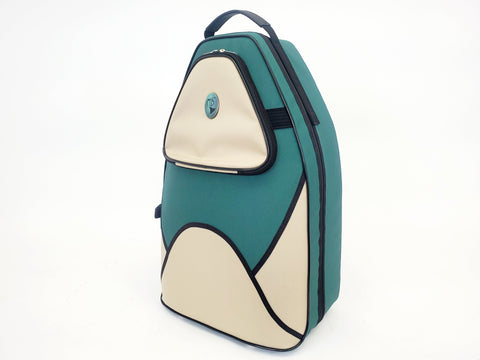
The Schmid includes a serviceable Protec case but its main zipper is worn, so 6" zipper area at one end doesn't get zipped. If you have a case already or don't care, we'll ship as is. If you'd like to upgrade to a fresher case it's no problem. Send a note and we'll arrange a quote for everything.
Philip Myers of the New York Philharmonic Orchestra plays the Schmid triple horn.
Transcription of an interview he did after the opening concert in 2005:
I met him [Engelbert Schmid] first in Illinois, and then one year later in France. And when I met him in France, I played one of his horns. I wanted it very much. But you know, always his horns have been very expensive. And they should be; they're that good. But it was new for me. But I liked this horn too much; I said, “I'm going to get this.” So I said, “I want to buy this horn.”
He said, “No, I'm sorry. You cannot have it. I have sold it to a man already. He has gone home. He is coming back tomorrow with his wife.” I said, “Does his wife know that he is spending this money?”
He said, “I don't think so.”
I said, “Well, maybe she will change his mind. Maybe I will get this horn.”
So she came in the next day [played the horn] and said, “You have made me so happy.”
Then I knew. So I ordered a horn from him, and it took six months. And when I got it, it was so much more money than I had ever spent for a horn, that I was afraid to play it. So I put it on the couch and left it there for two months. And then one night, I decided, “This is crazy, I must play it.” And that was it. I never went back.
The thing that makes it different is two or three things. One is, when you go to begin a note, it is absolutely solid from the first instant. And this is unusual. Usually with a horn, you're having to be careful a little bit at the beginning of a note. But with his, no. You just, pssshhh, and it gets there. You have to adjust to the horn, but with his horn, you don't have to make the adjustments.
The second thing is, in many horns, when you go to play loud, they get more forceful towards you, this way [points forward], but they don't get bigger this way [gestures broadly to the sides]. His horn gets bigger this way. You can hear this. Anybody can hear this. When you play his horns, you get wider and wider and wider. This is very unique.
And I would say the third thing is, it's very hard on a horn when you play loud to have it not be too intense, but when you play soft, to have it ring and be very lively. Again, his horns do this. They're lively when you play soft, but they don't get ugly when you play loud. This is very unusual. So I tell you something: This guy figured out something that other people do not know.
[Q: Do you think you ever will change again?]
[Laughs] Me? Not me. I just keep buying more of them. Really. That's right, they are like babies. I've got two of the same horn now, but I'm about to get a third, so, you know...
-Philip Meyers
Principal Horn, New York Philharmonic